The core of every package
HDR Photography, Bracketed for the Room and the View
Every frame is built from several exposures, layered so a bright window and a shaded room hold detail in the same photo. Packages run from 10 to 50 photos for homes up to 2,000 square feet.
Chapter 01
Why a bracketed photo reads three dimensional
A camera sensor cannot do what a walking-in eye does. Step into a room with a window full of afternoon light and your eye adjusts twice, once for the window and once for the room, so both look normal. A single exposure has to pick one: expose for the window and the room goes dark, expose for the room and the window burns out to a white rectangle. Bracketing solves this by taking several exposures of the same frame in quick succession, one for the highlights, one for the mid-tones, one for the shadows, and layering them together in post.
That layering is the mechanism behind the pitch: HDR photography produces larger, wider, clearer, and crisper images than a single exposure can, because it is drawing detail from three or four frames instead of asking one frame to cover a range of light it physically cannot capture. The result is not a trick, it is closer to what the room actually looks like standing in it, and that extra shadow and highlight detail is what gives a flat photo its sense of depth. Cabinet undersides, ceiling corners and the far wall of a hallway keep their shape instead of dissolving into black.
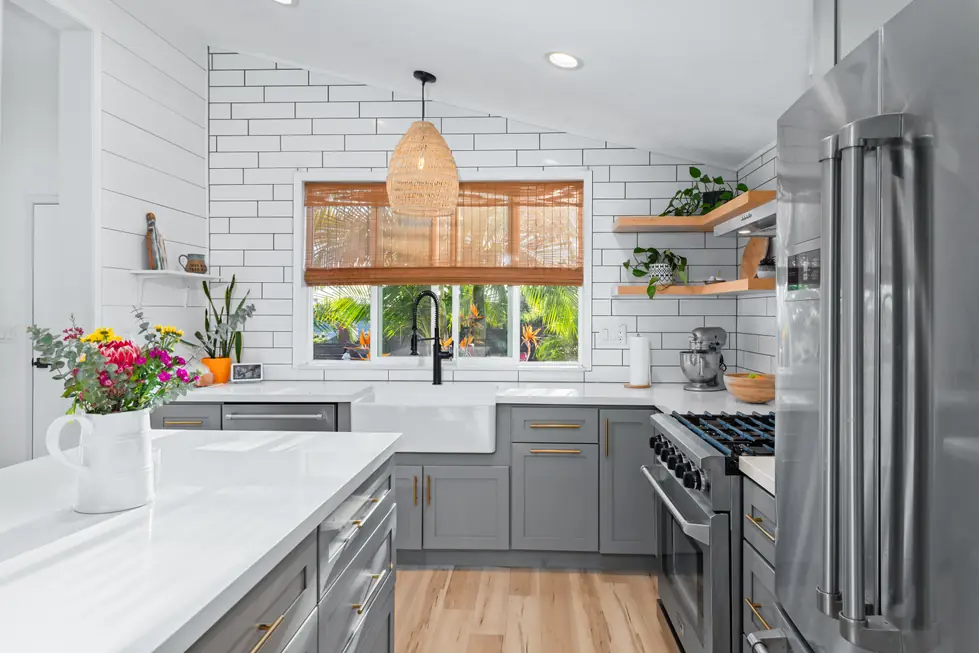
A high-end San Diego kitchen photographed with bracketed HDR exposures, holding detail through the windows and across the room
The window pull, solved instead of guessed at
A bright window against a darker interior is the single most common exposure problem in a real estate photo, and it is the one bracketing exists to fix. Expose for the interior and the window goes to a flat white glow, whatever view or yard sat behind the glass is gone. Expose for the outside and the room around it drops into shadow. The blended exposure holds both correctly at once, so the window shows real detail, trees, sky, a pool, a hillside, while the room in front of it stays properly lit.
That matters most exactly where it is easiest to lose: a listing where the view through the glass is part of what the home is selling. A blown-out window erases the reason a buyer would pay more for that room, and no amount of styling the interior makes up for a white square where the ocean or the yard should be.
Chapter 03
Sizing the package to the rooms worth showing
Packages run 10, 25, 35 or 50 HDR photos, for homes up to 2,000 square feet. Ten photos covers a small condo or a listing where only a handful of rooms are doing the selling. Twenty five is the workhorse count for a typical house: kitchen, living room, primary bedroom and bath, the exterior, and a couple of the stronger secondary angles. Thirty five and fifty make sense on larger homes or listings where more rooms genuinely earn a buyer's attention, multiple living areas, a finished bonus room, a backyard worth a few frames of its own.
The honest way to size it is to count rooms that would make someone stop scrolling, not rooms that exist. A house with one exceptional kitchen and an otherwise ordinary layout does not need fifty photos padding out hallway shots. A house with a view from four different windows usually does.
Add-ons that clean up the shot without changing the house
Sky replacement swaps a flat, overcast sky for a cleaner one on days the weather did not cooperate. Grass replacement handles a lawn that has gone patchy or brown in the exact week of the shoot, which happens more often than sellers expect. A floor plan gets added when the listing needs the room-to-room layout a buyer cannot piece together from stills alone, and it pairs naturally with an HDR package rather than replacing it.
None of these change what is actually in the house. They correct for what the camera caught on a particular day, the same way bracketing corrects for what a single exposure cannot hold, so the listing reflects the property rather than the weather or the season it happened to be photographed in.
SD Home Pix. Bracketed on site, no guesswork left for post. Call (619) 844-9392.