The frame people remember
Twilight and Blue Hour Photography
Shot in the window after sunset when the sky still holds colour and every window in the house reads warm. Added to any HDR package, on the same visit or a separate evening.
Chapter 01
The blue hour is short, and it does not wait
Blue hour is the window between sunset and full dark, when the sky still carries a gradient of blue and amber low on the horizon instead of going flat black. It moves with the calendar and the weather rather than the clock, so a twilight call time gets set close to the shoot instead of fixed weeks out. Once the sky goes dark, that particular gradient is gone until the next clear evening, which is why this is scheduled around the light rather than around a diary.
Inside that window two things are happening at once. The sky's brightness is dropping toward the interior's own brightness, instead of daylight simply outmatching every lamp in the house the way it does at noon, and every fixture inside starts to read as a warm point of light against a cooling sky rather than disappearing into an already-bright room. The shot is only possible while those two brightness levels are close enough to expose together, which is a narrower window than most people picture when they hear the word twilight.
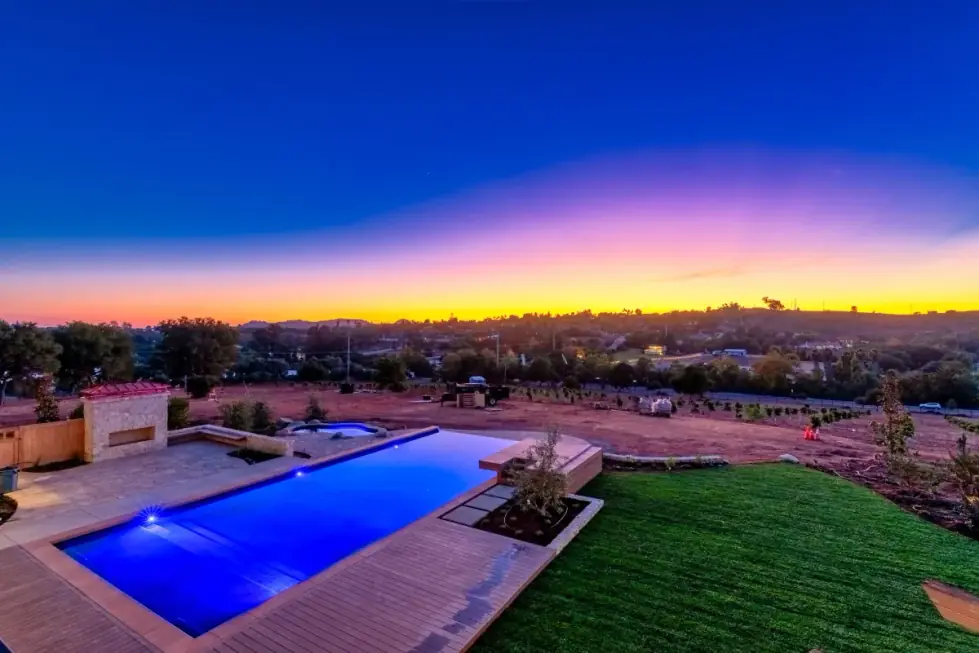
A San Diego backyard pool photographed at blue hour with a vivid sunset sky and warmly lit windows
Same visit or its own evening, a real trade-off either way
A twilight session is added onto a regular photo package, and it can be shot concurrently with the daytime visit or booked on its own separate day or time. Shooting it the same day means one trip to the property, and the interior is already staged and lit from the daytime session, but it also means a long gap between the daytime shots and sunset while everyone waits for the light.
Booking it separately means the twilight shoot happens on its own schedule, whenever the calendar and a clear evening line up, without holding up the rest of the package or the listing going live. The cost of that is a second visit, and on an occupied home, coordinating after-hours access twice instead of once.
Chapter 03
Balancing the lamps against the sky
Every interior light gets turned on before the exposure: lamps, ceiling fixtures, under-cabinet lighting, anything in frame. A twilight photo with half the house dark reads as unfinished rather than inviting. The exposure is set for the sky first, since that is the part of the frame changing fastest as the minutes pass, and the interior lighting is balanced against it afterward so the windows glow warm instead of either blowing out to white or going black.
It is the same bracketing principle behind an HDR interior, applied to the harder version of the problem. Instead of one bright window against one room, there are several windows all fighting a sky that keeps getting darker. Get the balance right and the house looks lived in against a real evening sky, not lit by a flash that makes it obvious a photographer was standing in the driveway.
How it gets added to a listing's package
A twilight session does not replace the daytime photos, it adds to them. The standard way it is sold is as its own set, listed as 25 Twilight HDR Photos, layered onto a regular HDR package rather than swapped in for it, so a listing carries both the daylight interiors that show the space clearly and the evening exterior that makes a scrolling buyer stop.
It works alongside any of the standard HDR photo counts, and because it is shot as its own short session, adding it to a booking does not change how the daytime portion of the shoot is planned.
SD Home Pix. One short window, planned for and not left to chance. Call (619) 844-9392.