Why One Exposure Can't Photograph a Room With a Window In It
A single shutter click can expose for the room or the view, never both. Here's the optical reason, and what fixes it.
September 22, 2026 · 4 min read
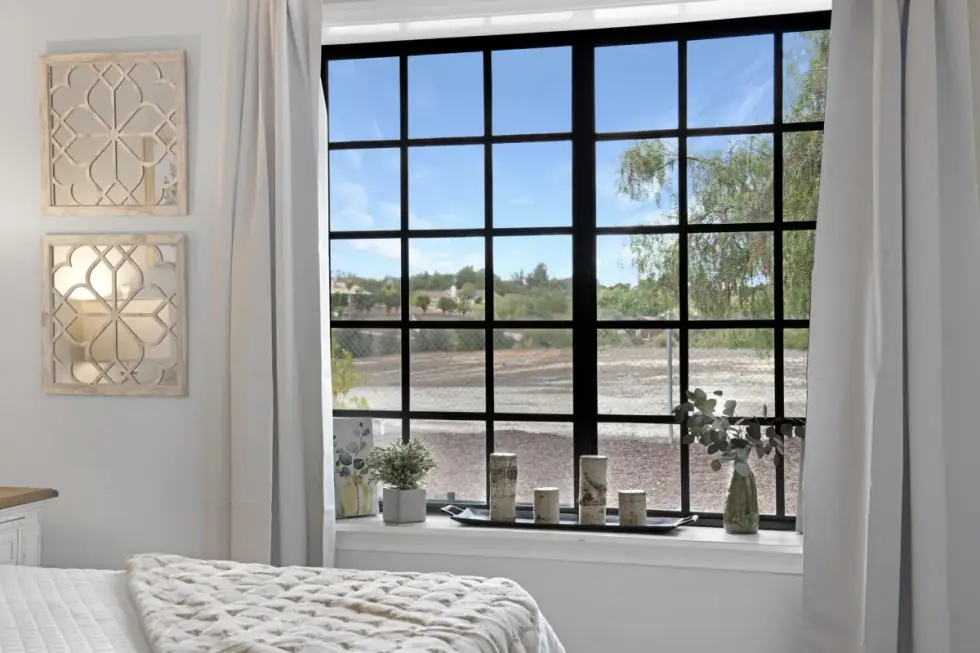
Point a phone camera at a bright window and you get one of two results: a lit room with a blown white rectangle where the view should be, or a visible garden through the glass with the room gone dark. There is no single exposure setting that fixes this. It is not a skill problem. It is a hard limit built into how a camera sensor measures light.
The room and the window are rarely the same brightness
A camera sensor can only hold a certain range of brightness in one frame, roughly the gap between the darkest tone that still reads as detail and the brightest one that hasn't gone to solid white. That range is called dynamic range, and it is finite. A living room lit by daylight bouncing off the walls might need a slow shutter to look properly exposed. The sky and the patio visible through the same window, in direct sun, can easily run six or seven stops brighter than that room. Expose for the room and the window burns out to a flat white card. Expose for the window and the room drops into shadow, furniture and floor going muddy and flat. One shutter click, one exposure value, can't serve both halves of that scene at once. It isn't that the photographer picked wrong. The scene itself doesn't fit inside one exposure.
What the eye does that a single photograph can't
Walk into that same room and it doesn't look like either failure. That's not because your eyes have dramatically more dynamic range than a sensor in any single instant, they don't. It's because your eyes never take one exposure. The pupil adjusts continuously and the eye scans the room in small movements, building up a composite impression from many quick glances at different brightness levels and stitching it together without you noticing. A photograph has to do that stitching before the shutter closes, not after, because a single frame only gets one exposure value for the whole scene. What the eye does automatically and invisibly, a camera has to be told to do on purpose.
What bracketing actually does
Bracketing means shooting the same frame several times at different exposures without moving the camera, then combining the results so each part of the image comes from whichever frame exposed it correctly. A fast exposure holds the detail in the window: the color of the sky, the shape of a tree line, the outline of a neighboring roof, without blowing it to white. A slower exposure lights the room properly, keeping the wood floor, the cabinetry, and the far corners readable instead of falling into shadow. The blend takes the correctly exposed pixels from each frame and leaves the rest out. This is the actual mechanism behind what real estate listings call HDR photography. It isn't a filter or a preset applied afterward. It's solving an optical problem a single frame can't solve, by giving the scene more than one chance to be exposed correctly.
What a correctly pulled window looks like next to a blown one
A properly pulled window shows the actual view: sky with some color and texture in it, the tree line, the neighboring rooftop, the pool deck. It should still read as daylight, not as a second interior lit with a flashlight. A blown window is a flat white rectangle with no information in it at all, and it erases whatever the buyer was supposed to notice through it. That distinction matters more here than in a lot of markets, because so much of what a San Diego listing is actually selling sits outside the glass. A canyon view, an ocean glimpse, a palm-lined street ends up either present in the photo or missing from it entirely, depending on whether the exposure was handled as one shot or several.
Why a phone's built-in HDR mode doesn't fully solve this
Most phones now shoot some version of automatic HDR, and it does bracket exposures the same way in principle. The difference shows up in how much control the process gives over the result. A phone's algorithm decides on its own how aggressively to pull the highlights and how much to lift the shadows, tuned for a general photo rather than a listing where the window view is the point. A room with a strong window and a dim interior corner is exactly the scene where an automatic blend tends to either play it safe and still lose some sky, or overcorrect and leave the room looking flat and gray. Manual bracketing with a full set of exposures and a deliberate blend gives the same basic tool more range to work with and a person deciding, frame by frame, how much of each exposure actually belongs in the final image.
None of this shows up as a line item anywhere. It shows up as whether the room in the photo looks like somewhere the light gets in, or like a box with a window-shaped hole in one wall. For a listing photographed once and judged in a few seconds of scrolling, that difference is most of the job.
SD Home Pix, (619) 844-9392
Call (619) 844-9392More articles
The Blue Hour Is Shorter Than You Think, and That Changes How You Schedule a Shoot
The twilight window that sells a listing is short and doesn't wait for a late start. Here's how to schedule around it.
Matterport or Zillow 3D: How to Choose, and Why You Might Want Both
Two tour platforms solve two different problems. Here's what each is actually good at, and when a tour is worth booking at all.